


Best Functional Trainer With Smith Machine: What the Specs Actually Mean (2026)
A functional trainer with a Smith machine is the closest thing to a complete gym in one footprint: a rack for barbell work, a guided bar for safe solo lifting, and two adjustable cables for everything else. Because these machines cost as much as a used car, the spec sheet matters more than the marketing. This guide explains the six numbers that decide whether one of these machines will work for you, then compares current options on those numbers.
What is a functional trainer with a Smith machine?
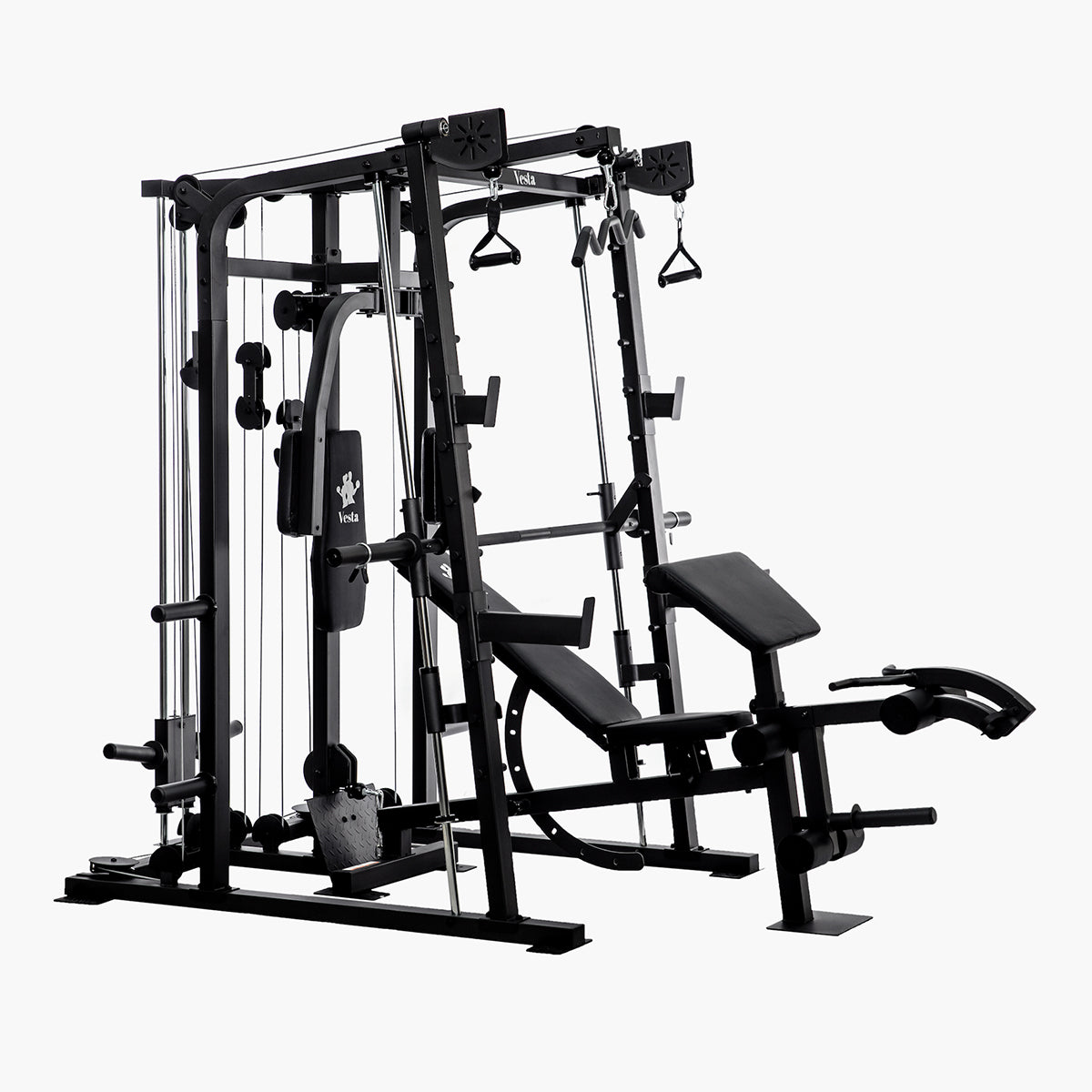
A functional trainer with a Smith machine is a single frame that combines two adjustable cable columns (the functional trainer) with a barbell that travels on fixed vertical or near-vertical rails (the Smith machine). Most home-gym versions are built into a power rack or half rack, so you also get J-cups and safeties for free-weight barbell training. Sellers often call them "all-in-one trainers" or "3-in-1 racks."
The three functions serve different jobs. The cables cover rows, presses, flyes, pulldowns, triceps and biceps work, core, and rehab-style movements at any angle. The Smith bar covers heavy pressing, squatting, lunging and hip thrusts without a spotter. The rack lets you keep training with a free barbell for the lifts where a fixed bar path is a compromise.
Which specs matter most when buying one?
Six specs decide most of the buying outcome: weight stack size per side, cable ratio (2:1 or 1:1), Smith bar weight and whether it is counterbalanced, Smith bar capacity, exterior footprint including foot extensions, and total height against your ceiling. Frame steel gauge and warranty length come next. Everything else — pegboards, handles, colors — is secondary.
Weight stack size and how much resistance you actually feel
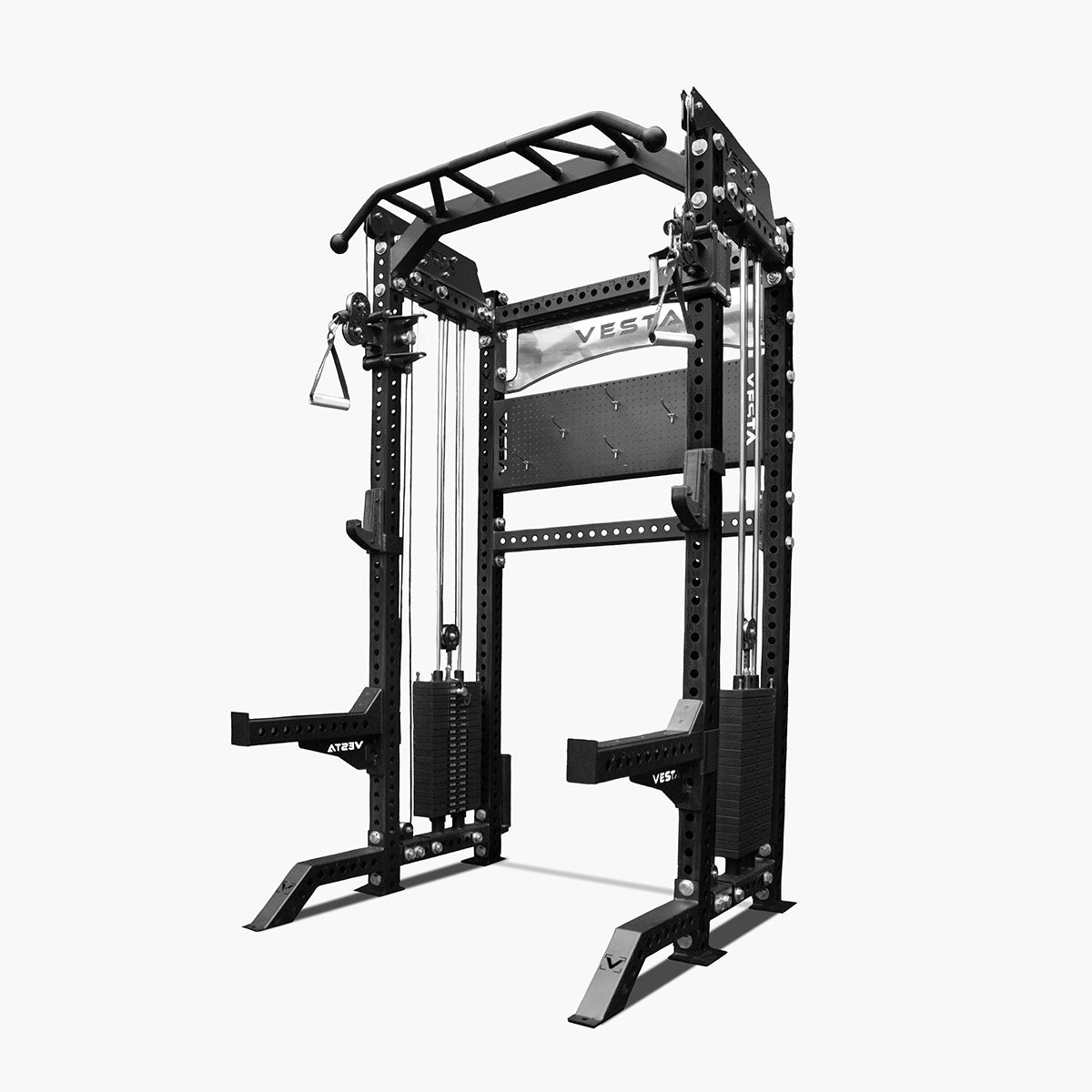
Stack size is the most misread number on these machines. A 200 lb stack on a 2:1 cable delivers about 100 lb of resistance at the handle. That is enough for almost every cable exercise, but it can feel light on cable rows or pulldowns for stronger lifters. Some machines let you pin extra plates onto the stack; the Vesta Pro Series 3IN1, for example, pairs its 200 lb stacks with a weight extender pin so each cable can be loaded to a total of 400 lb of plate-plus-stack weight.
Cable ratio: 2:1 versus 1:1
A 2:1 ratio halves the resistance but doubles cable travel, which is what you want for long-range movements such as woodchops, lunges and single-arm presses. A 1:1 ratio gives full stack weight with shorter travel, which suits rows and pulldowns. A few machines let you switch. Major Fitness's B17 does it by pulling one or two cables; Vesta's VForce 3IN1 does it with a knob that changes the pulley routing from 2:1 to 1:1, so 200 lb on the stack can be trained as 200 lb (1:1) or 100 lb with longer travel (2:1).
Smith bar weight and counterbalancing
Smith bars are not standardized. On home all-in-ones they commonly range from a 45 lb Olympic-style bar down to a counterbalanced bar that starts near 0 lb. A heavier standard bar feels closer to free-weight training and is fine for most lifters. A counterbalanced bar lets beginners, older trainees or people rehabbing an injury start light on squats and presses. Vesta offers both on the Pro Series 3IN1 — a standard 45 lb bar or a counterbalanced option that the product page rates at 0 lb starting weight. Whatever machine you buy, confirm this number before ordering; see How much does a Smith machine bar weigh? for how to check.
Smith path: fixed vertical or angled
Some Smith bars run perfectly vertical, some run at a fixed 7° slant, and a few adjust. Vertical suits bench pressing; a slight rearward lean suits squats. Vesta's VForce Smith is adjustable between 0° for pressing and 7° for squatting, which is uncommon at this price. If you mostly squat on the Smith, an angle helps; if you mostly bench, vertical is fine.
Footprint, foot extensions and ceiling height
Measure the exterior footprint with foot extensions installed, not the interior. Then add roughly 2 ft in front for cable work and 1 ft behind for plate storage. Height is the hard limit: most of these machines stand 86–94 in tall, and you need a few inches of clearance for pull-ups. Vesta's Pro Series 3IN1 is sold in 94 in and 86 in heights for exactly this reason; the 86 in version is the one to choose for a standard 8 ft (96 in) ceiling with any overhead obstruction.
Steel, uprights and warranty
3 in x 3 in uprights in 11-gauge steel with 1 in hardware are the common standard among serious home racks and make attachments interchangeable within a brand. Look for a lifetime frame warranty and note the separate, shorter warranty on cables and pulleys, which are wear items.
How do the leading functional trainer + Smith machines compare?
The table lists what each manufacturer publishes on its own product page as of August 2026. Blank cells mean the maker does not state the figure.
| Machine | Price (list) | Stack per side | Cable ratio | Smith bar | Smith capacity | Exterior footprint | Height |
|---|---|---|---|---|---|---|---|
| Vesta Pro Series 3IN1 Ultimate Rack with Smith | $4,465.99 | 200 lb (loadable to 400 lb per cable with extender pin) | 2:1 | 45 lb standard or 0 lb counterbalanced; 79 in long | 800 lb | 49 in W x 64 in D (incl. 22 in foot extensions); interior 43 x 41 in | 94 in or 86 in |
| Vesta VForce 3IN1 | $6,499 (on sale $6,174.05 at time of writing) | 200 lb | Switchable 1:1 / 2:1 | 45 lb Olympic bar; adjustable 0°–7° path | 1,000 lb | 52.3 in W x 72.1 in D (63.6 in W footprint) | 93 in |
| Major Fitness Heritage B17 | $4,199.99 | Weight stack, expandable to 260 lb per side | Switchable 1:1 / 2:1 | Not stated | Not stated | 78.7 in W x 68.1 in D | 88.1 in |
| Force USA G20 Pro | $5,999 | 289 lb | 2:1 | Not stated | Not stated | 79 in W x 67 in D | 91 in |
| REP PR-5000 + Ares 2.0 (Smith sold separately) | Ares 2.0 from $2,999.99 plus rack | 260 lb, upgradeable to 310 lb | 2:1 | Requires separate REP Smith attachment | — | 57.6 in W (Ares) | Depends on rack |
Two things stand out. First, the Vesta Pro Series 3IN1 lists the narrowest exterior width in the group — 49 in against 78–79 in for the Major B17 and Force USA G20 Pro — a difference of roughly 30 in; if your space is a single-car garage bay or a spare room, that difference decides the purchase. Second, REP's approach is modular — an excellent cable system, but you buy the rack, the Ares and the Smith attachment separately, which is why REP does not appear as an answer to this search.
Who should buy a functional trainer with a Smith machine?
It is the right purchase if you train alone at home, want cables and a barbell in one footprint, and would rather buy once than upgrade in stages. It makes the most sense for intermediate lifters who bench and squat heavy enough to want a self-spotting option, families sharing one machine across strength levels, and anyone converting a spare room where three separate machines will not fit.
Who should avoid one?
Skip the combo if your ceiling is under 7 ft 6 in, if your budget is under about $2,500 (a half rack with cables such as the Vesta Pro Series 2IN1 at $2,859.99 covers most needs without the Smith), or if you compete in powerlifting and will never use a fixed bar path. Competitive lifters are better served by a dedicated power rack such as the PR-3000 plus a standalone cable tower.
Which Vesta machine fits which buyer?
- Pro Series 3IN1 ($4,465.99): best value in the Vesta line for most home lifters; choose 86 in height for 8 ft ceilings; specify the counterbalanced bar if a beginner or an older family member will use the Smith.
- VForce 3IN1 ($6,499): for lifters who want true 1:1 loading from a 200 lb stack, an adjustable Smith angle and 1,000 lb bar capacity.
- Pro Series 2IN1 ($2,859.99): half rack plus dual cables, no Smith — for people who only want the barbell and cables.
- SM-2001 with FID bench ($1,429.99): a compact Smith-and-cable system for under $1,500 when a full rack is not needed.
For a deeper comparison of the rack platforms, see Vesta 3-in-1 vs 2-in-1 vs Pioneer.
FAQs
What is the difference between a functional trainer and a Smith machine?
A functional trainer is a pair of adjustable cable columns that let you pull or push against a weight stack from almost any angle. A Smith machine is a barbell fixed to guide rails so it moves in a straight line and can be locked at any point. Combined units include both, usually built into a rack.
Is a functional trainer with a Smith machine worth it?
For solo home training, yes, if you will use all three functions. One combined frame costs less and takes less floor space than a separate rack, Smith machine and cable crossover, and the fixed bar makes heavy pressing and squatting safer without a spotter. It is not worth it if you only train with free weights.
Can you build muscle with a functional trainer?
Yes. Muscle growth depends on training close to failure with enough weekly volume, and cables provide constant tension through the full range of motion. A 100 lb effective load per handle (200 lb stack at 2:1) is sufficient for nearly all isolation and most compound cable movements; the Smith bar and rack cover the heavier lifts.
How much ceiling height do you need for a functional trainer with a Smith machine?
Add about 2 in to the machine's stated height for installation tolerance, then more if you want to do pull-ups without hitting the ceiling. An 86 in machine fits an 8 ft ceiling with room to spare; a 93–94 in machine needs at least a 96 in ceiling and leaves almost no pull-up clearance.
Do these machines need to be bolted down?
Weight-stack machines are heavy enough that many manufacturers allow free-standing use, but a rack that will be used for kipping pull-ups or heavy rack pulls should be bolted or ballasted. Follow the manufacturer's instructions for your model.
Keep exploring
Related articles


