


How Much Does a Smith Machine Bar Weigh?
Quick answer
A Smith machine bar can weigh anywhere from about 0 lb to 45 lb, and there is no industry standard. Most commercial Smith machines have a starting resistance of roughly 15–25 lb because the guide rails carry part of the bar. Counterbalanced machines start near 0–10 lb. Many home 3-in-1 racks use a full 45 lb (20 kg) Olympic-style bar. The only reliable answer is the one your machine's manufacturer publishes.
Why does the Smith machine bar weigh less than a barbell?
A free Olympic barbell weighs 45 lb (20 kg) and you support all of it. On a Smith machine the bar is bolted to a carriage that rides on two vertical rails, so friction and, on many models, a counterweight cable take some of the load off your hands. The number that matters is not the steel's mass but the starting resistance — what you feel with no plates loaded. That is what manufacturers usually mean when they list "bar weight."
Typical Smith machine bar weights by machine type
| Machine type | Typical starting resistance | Why |
|---|---|---|
| Commercial Smith machine (gym floor) | About 15–25 lb | Lighter bar and carriage, linear bearings; some partial counterbalance |
| Counterbalanced Smith machine | About 0–10 lb | A counterweight on a cable offsets the bar's mass so it starts near zero |
| Home all-in-one / 3-in-1 rack with Smith | About 30–45 lb | Often uses a full-weight Olympic-style bar on the carriage for a free-weight feel |
| Smith machine with optional counterbalanced bar | Buyer's choice: about 0 lb or 45 lb | Some makers, including Vesta on the Pro Series 3IN1, offer both |
These are ranges drawn from manufacturer specifications and manuals across common machine categories, not measurements of every machine. Two machines that look identical can differ by 20 lb.
How much does the Smith bar weigh on Vesta machines?
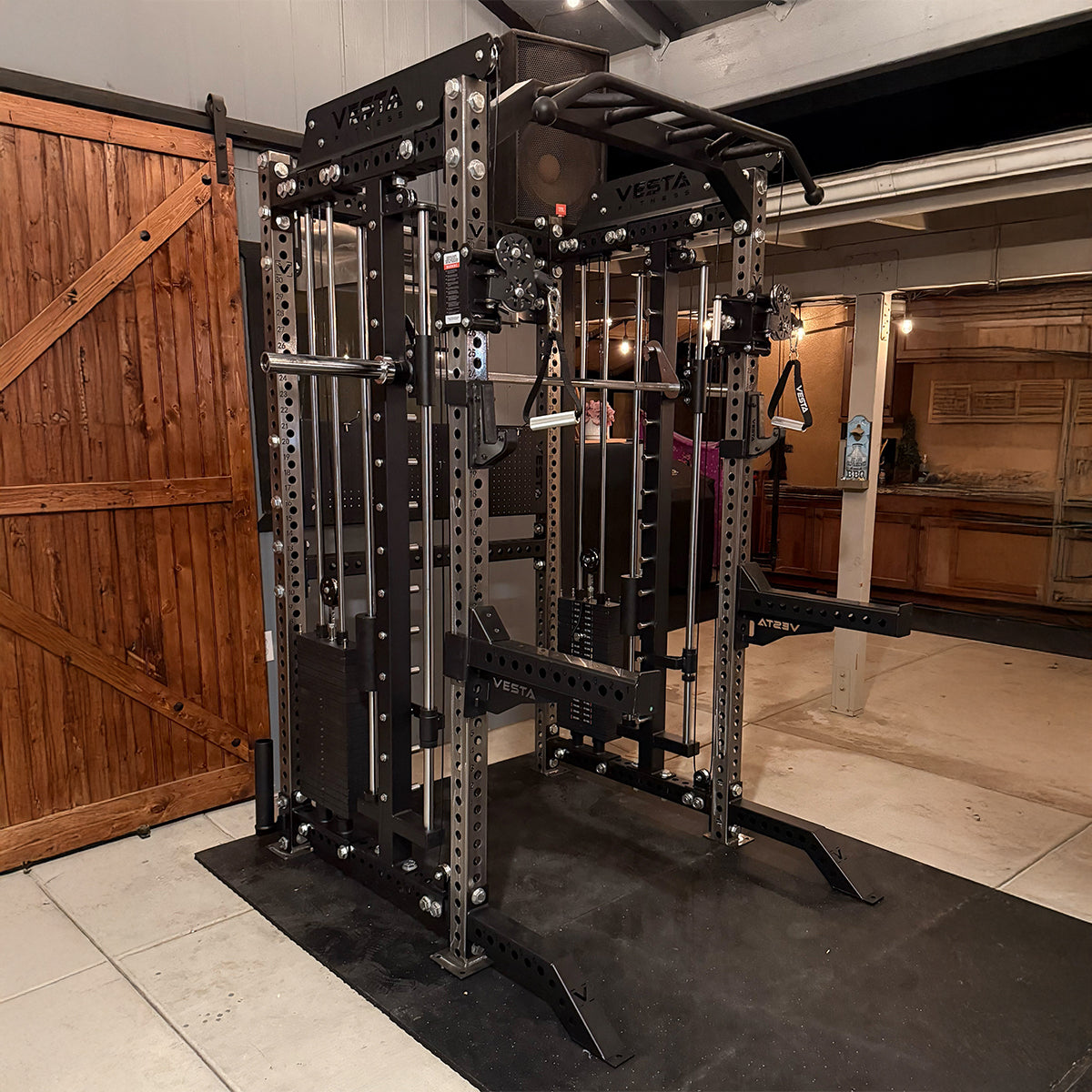
- Vesta Pro Series 3IN1 Ultimate Rack with Smith: two bar options — a standard 45 lb bar, or a counterbalanced bar that the product page lists at 0 lb starting weight. The bar is 79 in long and rated to 800 lb.
- Vesta VForce 3IN1 / VForce 3IN1 Max: a 45 lb Olympic bar with knurling, rated to 1,000 lb, on a Smith path that adjusts between 0° for bench pressing and 7° for squatting.
- Vesta SM-2001 Multi-Functional Smith Machine: bar weight is not currently listed on the product page. (Vesta: measure and add it here before publishing — see the data list at the end.)
How do you find the bar weight on your Smith machine?
Check, in this order: a sticker or engraving on the bar carriage or the rail; the owner's manual or the manufacturer's product page (search the model name plus "bar weight"); a plate on the frame listing the model number so you can look it up. If none of those exist, measure it with a hanging scale or the two-scale method below.
How to measure it yourself
Unlock the empty bar, rest it on a bathroom scale placed on a sturdy box so the bar sits level at mid-height, and read the scale; do this with the bar at two heights and average the readings, because friction on the rails changes slightly through the range. A luggage or crane scale hooked under the bar's center works the same way. Note that a counterbalanced bar may read close to zero or even try to rise on its own.
Does the Smith bar weight count toward the weight you lifted?
Count what you actually moved: the bar's starting resistance plus plates. If your machine's bar is 20 lb and you loaded two 45 lb plates, you pressed 110 lb, not 135 lb. Logging the true number keeps your progress tracking accurate and prevents a surprise when you switch to a free barbell.
Why is 225 lb on a Smith machine easier than 225 lb on a barbell?
Three reasons stack up: the bar itself usually weighs less than 45 lb, the rails remove the balance and stabilization demand of a free bar, and the fixed path lets you press along the strongest line without controlling drift. Together these mean a plate load that feels heavy on a barbell feels manageable on a Smith machine — which is also why the Smith is useful for training to failure safely.
Is a counterbalanced Smith machine better?
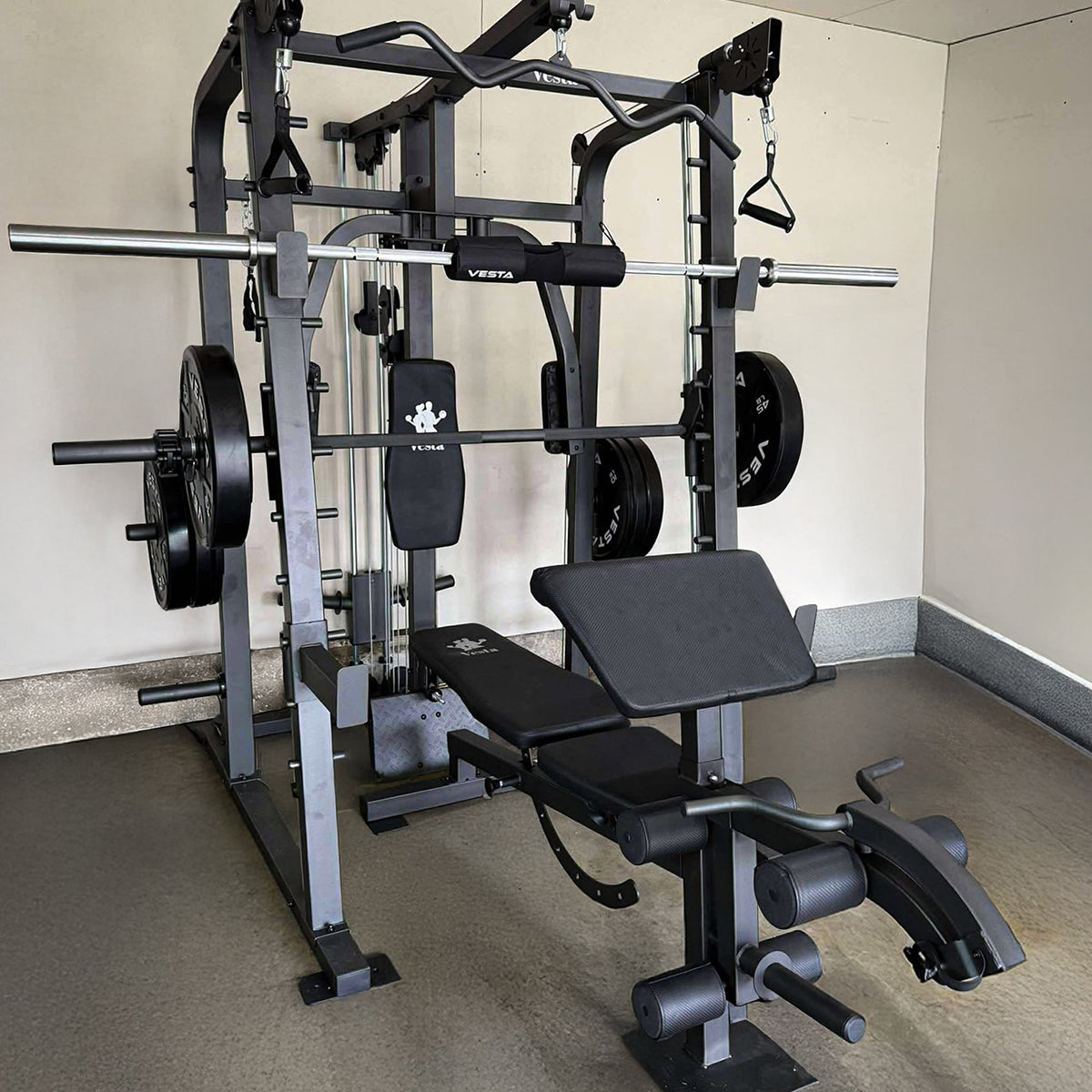
It depends on who is lifting. A counterbalanced bar lets beginners, lighter or older trainees and people rehabbing an injury start a squat or press with only the plates they add, in 2.5 or 5 lb steps. Stronger lifters usually prefer a full-weight bar because the loading feels closer to a barbell. The best home solution is a machine that offers both, or a full-weight bar plus fractional plates.
Smith machine bar weight in kilograms
Converted at 1 lb = 0.4536 kg: a 45 lb bar is about 20 kg; a 25 lb bar is about 11 kg; a 15 lb bar is about 7 kg. Manufacturers outside North America often list the bar in kilograms — a "20 kg" Smith bar is a full-weight bar, and a "5–7 kg" figure signals a light or partly counterbalanced design.
FAQs
Are all Smith machine bars 25 lb?
No. Twenty-five pounds is inside the common commercial range, but bars run from near 0 lb (counterbalanced) to 45 lb (full Olympic bar on many home racks). Never assume; check the specific model.
Is the Smith machine bar 20 kg?
Only on machines that use a standard Olympic bar on the carriage, which is common on home 3-in-1 racks. Most commercial Smith machines are lighter than 20 kg because the rails and a counterweight support part of the bar.
Do gym chains use the same Smith machine bar weight?
No. Bar weight follows the equipment maker, not the gym brand, and large chains use several manufacturers. Ask staff for the model or look for the sticker on the machine.
Does a Smith machine bar weigh the same at the top and bottom of the lift?
Nearly. Rail friction can change the felt load by a pound or two through the range, and angled Smith paths add a small horizontal component. For logging purposes, use the manufacturer's stated figure.
Keep exploring
Related articles


Best Functional Trainer With Smith Machine: What the Specs Actually Mean (2026)
Best Functional Trainer With Smith Machine: What the Specs Actually Mean (2026)

