


Smith Machine vs Power Rack: Which Should You Buy for a Home Gym?
Quick answer: Smith machine or power rack?
Buy a power rack if you want to build maximal strength with a free barbell and are willing to learn to use safety arms. Buy a Smith machine if you train alone, prefer a guided bar for pressing, squatting and hip thrusts, or share the equipment with beginners. If you have the budget and floor space, a rack with an integrated Smith bar removes the trade-off.
What is the actual difference between a Smith machine and a power rack?
A power rack is a steel frame that holds a free barbell on J-cups and catches it on adjustable safeties; the bar moves however you move it. A Smith machine fixes the barbell to vertical or slightly angled guide rails so it travels in a straight line, and it can be hooked and locked at any point. The rack trains the movement; the Smith machine constrains it.
That single difference drives every other comparison below: safety, exercise selection, how the weight feels, floor space and price.
Which is safer for lifting alone?
Both are safe when set up correctly, but they fail differently. A Smith machine lets you lock the bar with a wrist rotation at any point in the lift, which is why it feels safer. A power rack with safety arms set just below your lowest position is equally safe for squats and bench — the bar simply lands on the safeties — but only if you set them every session and never skip them.
Where Reddit's r/GarageGym threads and most coaches agree: the danger with a rack is user error (safeties set too low or not at all); the danger with a Smith machine is complacency, because a fixed path can hide poor mechanics until you move to free weights. Both Vesta racks ship with spotter arms; the PR-3000 uses 2 in hole spacing so the safeties can be set close to your actual sticking point.
Which builds more muscle and strength?
For strength that transfers to sport and daily life, the free barbell in a power rack wins because it forces you to stabilize the load. Research comparing free-weight and Smith-machine squats (Schwanbeck and colleagues, 2009) found higher activation of stabilizing muscles with the free bar at the same relative load. For hypertrophy, the difference is small: muscle growth depends on effort and volume, and a Smith machine lets many lifters push closer to failure safely on presses, squats, split squats and hip thrusts.
Practical translation: powerlifting or athletic goals favor the rack; physique goals or joint-friendly training can be served equally well by either.
Which offers more exercises?
A power rack offers more total exercises because it accepts any barbell movement plus rack attachments — dip bars, landmines, lat pulldown seats, leg curl/extension units and cable systems. A Smith machine offers fewer barbell movements (no Olympic lifts, no free-path pressing) but makes several exercises easier to load heavily alone: hip thrusts, incline presses, Bulgarian split squats, calf raises and inverted rows.
| Exercise | Power rack | Smith machine |
|---|---|---|
| Back squat, front squat | Yes, free path | Yes, fixed path |
| Bench press (flat/incline) | Yes, with safeties | Yes, self-spotting |
| Deadlift, Romanian deadlift | Yes (from floor or safeties) | Limited — bar path and height restrictions |
| Overhead press | Yes | Yes, but the vertical path can be awkward for some shoulders |
| Hip thrust | Yes, with a barbell pad | Yes — easier to set up alone |
| Rows (barbell, inverted) | Yes | Yes |
| Olympic lifts, landmine work | Yes | No |
| Pull-ups, dips (with attachments) | Yes | Some models |
| Cable work | Only with a cable attachment or 2-in-1/3-in-1 rack | Only on combo units |
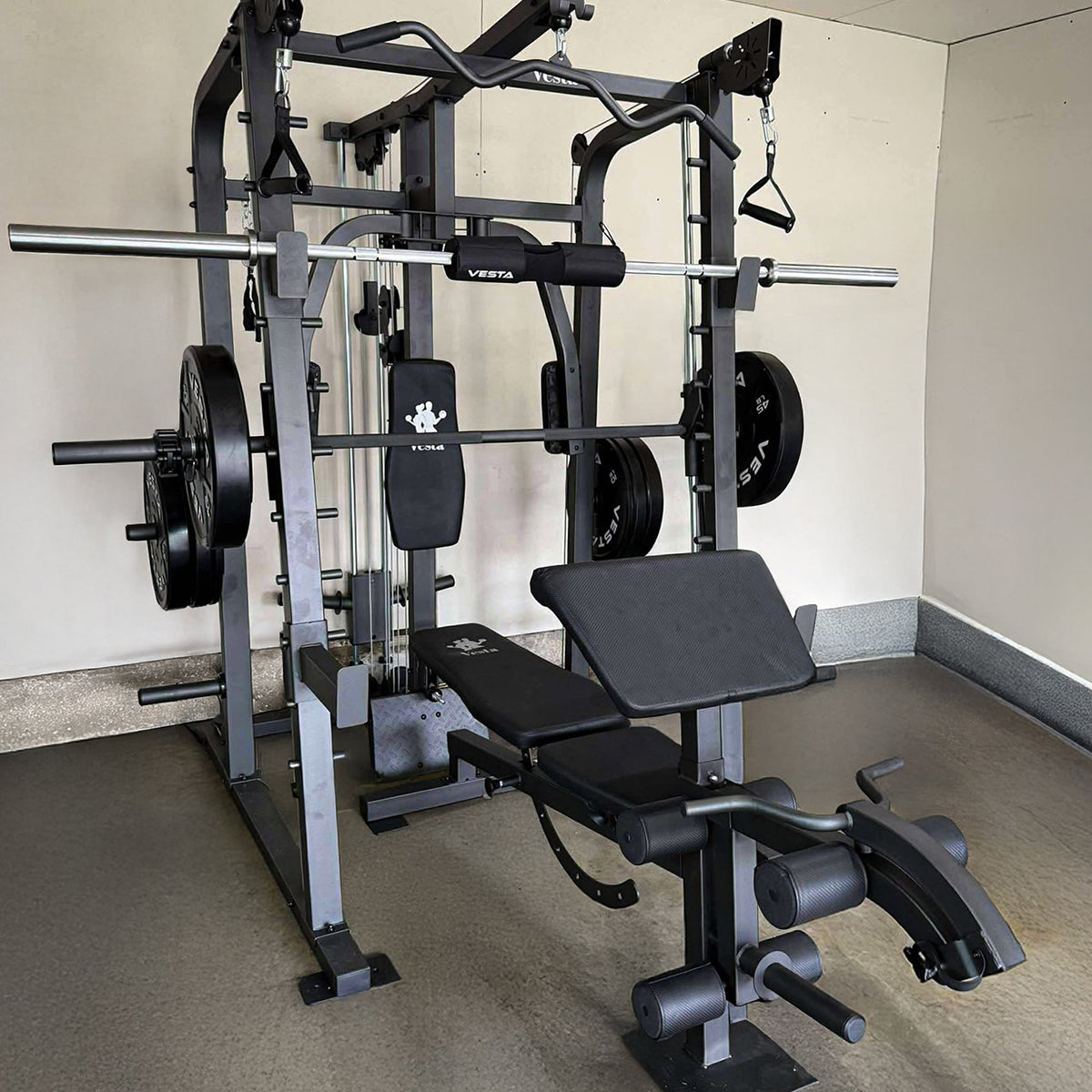
How does the bar weight differ on a Smith machine?
A power-rack barbell is almost always 45 lb (20 kg). Smith machine bars are not standardized: on commercial machines they typically weigh 15–25 lb because the carriage and rails carry part of the load, and some are counterbalanced to near 0 lb. On home 3-in-1 racks the Smith bar is often a full 45 lb, and Vesta's Pro Series 3IN1 offers either a 45 lb bar or a counterbalanced option. The practical result is that "225 on the Smith" is rarely the same as 225 on a free bar; see How much does a Smith machine bar weigh? for how to check your machine.
How much space does each one need?
A full power rack such as the Vesta PR-3000 stands 90 in tall and 52 in deep; add about 4 ft of width for a 7 ft barbell to load plates, so plan on a floor area of roughly 8 ft x 6 ft and a ceiling of at least 92 in (7 ft 8 in) — more if you want pull-up clearance. Stand-alone Smith machines with a lat and cable station are similar in height and often wider once the weight-plate storage horns are counted. A combined rack-plus-Smith unit like the Pro Series 3IN1 measures 49 in wide by 64 in deep (including 22 in front foot extensions) and comes in 94 in or 86 in heights, so it can replace both machines in less space than either one plus a separate cable tower.
If ceiling height is your constraint, a folding or wall-mounted rack at 7 ft or shorter — Vesta's Foldable Wall Mount Rack — beats any Smith machine, none of which fold.
What do they cost?
| Option | Typical price range (Aug 2026) | Vesta example |
|---|---|---|
| Entry power rack, 2x2 or 2x3 uprights | $300–$600 | PR-1000 |
| Full 3x3 11-gauge power rack | $700–$1,500 | PR-3000, $1,099.99 |
| Smith machine with cable/lat station and bench | $1,000–$2,000 | SM-2001 with FID bench, $1,429.99 |
| Rack + Smith + dual weight-stack cables (3-in-1) | $4,000–$6,500 | Pro Series 3IN1 from $4,465.99; VForce 3IN1 $6,499 |
A rack also needs a barbell and plates (budget $400–$900), whereas most Smith machines include the bar but still need plates.
Smith machine pros and cons
Pros: self-spotting at any point in the lift; easier to load heavy alone on hip thrusts, presses and split squats; forgiving for beginners and rehab; many models bundle a cable/lat station and bench.
Cons: fixed path removes stabilizer demand and can mismatch some people's natural squat or press path; no deadlifts from the floor on most units; bar weight varies by machine; no Olympic lifts; cannot fold or wall-mount.
Power rack pros and cons
Pros: every barbell movement; free-bar strength that transfers; attachment ecosystem (dips, landmine, cables, leg curl, lat seat); folding and wall-mount versions for tight garages; lowest entry price.
Cons: safety depends on setting safeties correctly; heavy solo pressing takes confidence; you buy the bar and plates separately; cables require an add-on or a 2-in-1/3-in-1 platform.
Who should choose a Smith machine?
Choose a Smith machine if you are new to barbell training, train alone and want to press and squat heavy without a spotter, are working around a shoulder or knee that dislikes free-bar paths, or want one machine that also covers lat pulldowns and cable rows in a compact space.
Who should choose a power rack?
Choose a power rack if strength is the goal, you deadlift and want the option to learn Olympic-style lifts, you want to expand with attachments over time, or you have a low ceiling or a shared garage where a folding rack matters. Read Why a Power Rack Is the Heart of a Great Home Gym for the full case.
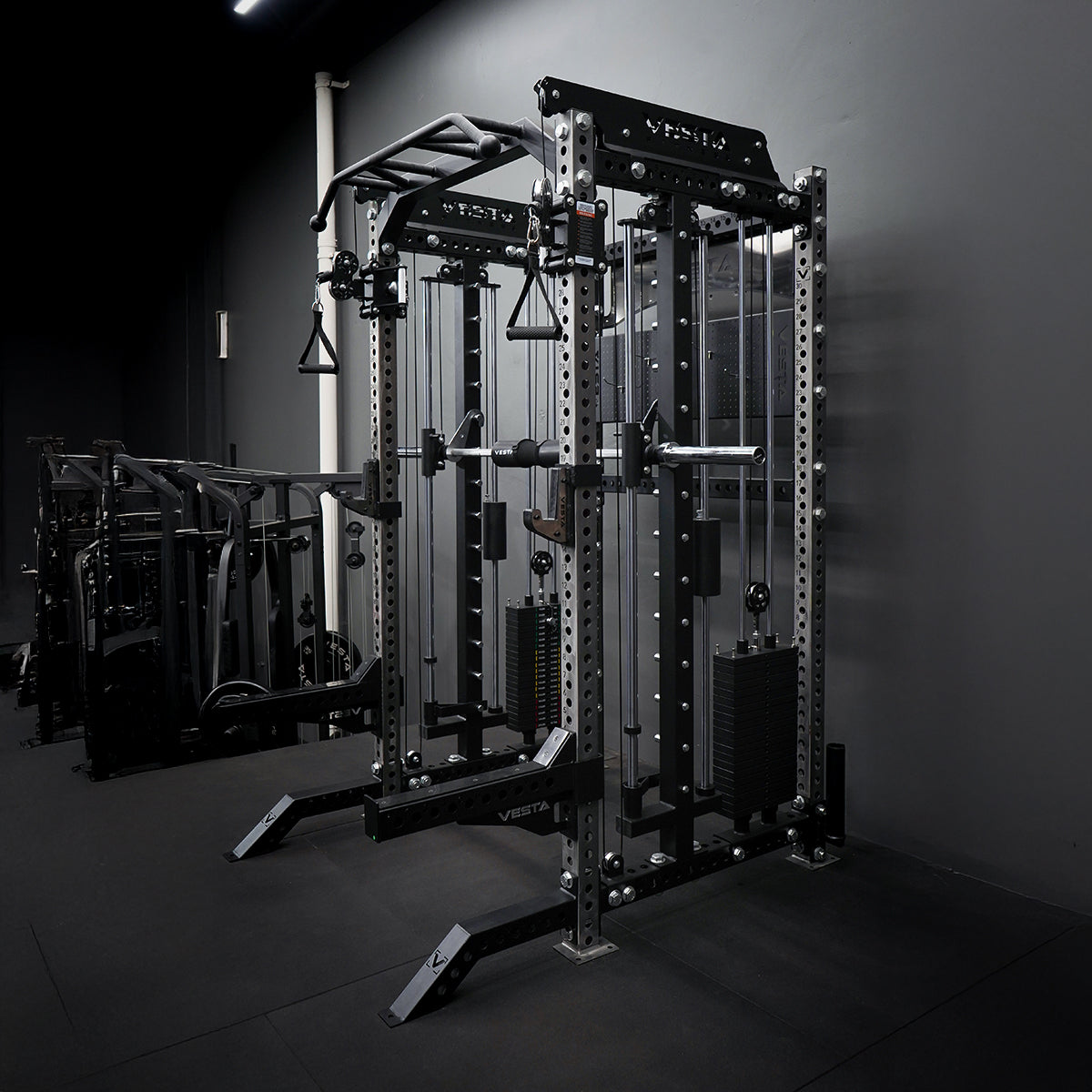
Should you just get both in one rack?
If your budget clears about $4,000 and your floor space is at least 5 ft by 7 ft, a rack with an integrated Smith bar
Keep exploring
Related articles


Best Functional Trainer With Smith Machine: What the Specs Actually Mean (2026)
Best Functional Trainer With Smith Machine: What the Specs Actually Mean (2026)

